

MENU
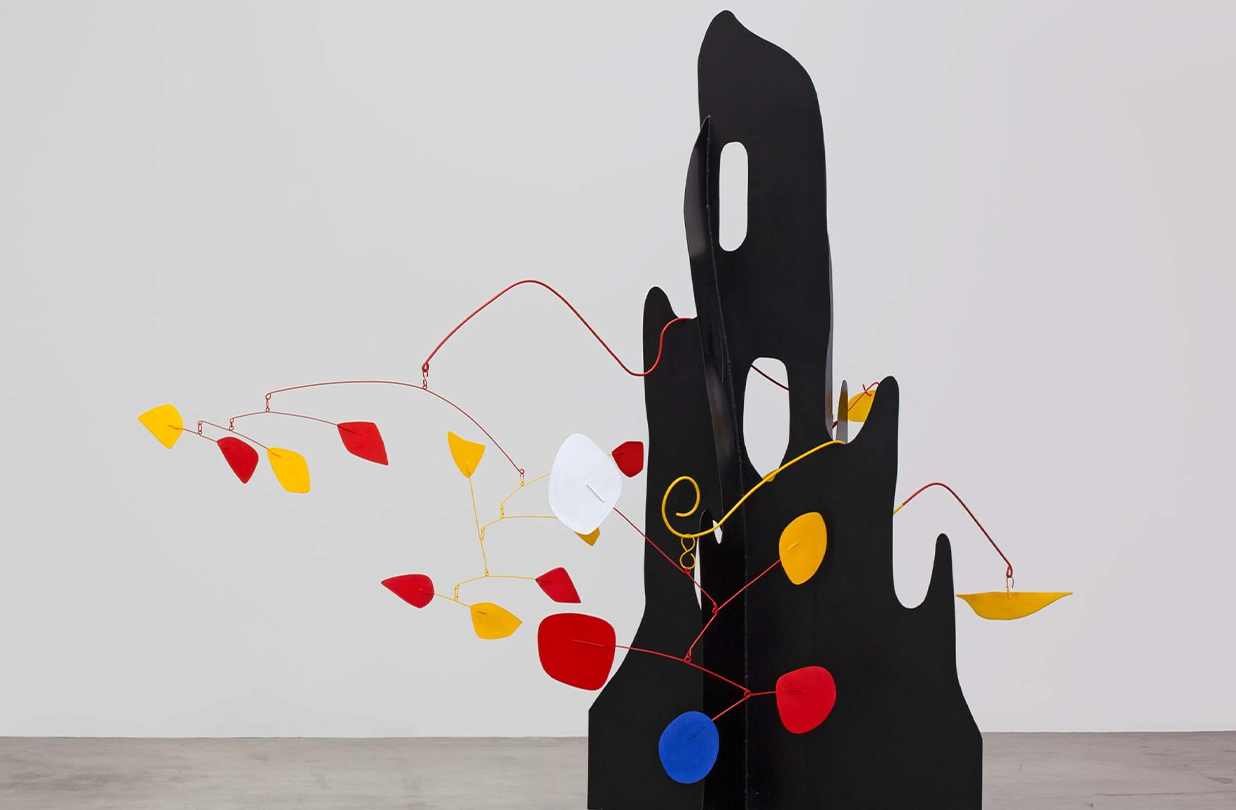
Few 20th-century artists are as instantly recognizable as Alexander Calder. His delicately balanced mobiles, kinetic sculptures that drift with the faintest air current, redefined what sculpture could be and helped usher in a new era of modern art.
This overview covers Calder’s journey from mechanical engineer to art-world icon, explains his signature styles, highlights important works, and looks at how his market has evolved for today’s collectors.
Born in 1898 into a family of artists, Calder spent his childhood surrounded by creativity yet initially pursued mechanical engineering at the Stevens Institute of Technology. The technical skills he acquired there later proved invaluable in crafting perfectly balanced kinetic forms.
After brief stints in industrial jobs, Calder shifted to art full-time, studying at the Art Students League in New York before moving to Paris in 1926. It was in the expatriate circles of Montparnasse that he forged friendships with Joan Miró, Piet Mondrian, and other modernists who nudged his work toward abstraction.
In 1931 Calder suspended abstract shapes from thin wire and discovered that slight air currents could set them in motion. The critic Marcel Duchamp coined the term “mobile,” capturing both their movement and poetic lightness.
Unlike static bronze or marble works, a Calder mobile continuously re-composes itself, turning viewers into participants. The engineering challenge lay in distributing weight so each element floated effortlessly, and Calder’s background allowed him to solve this with intuitive precision.
While mobiles dominate popular imagination, Calder’s creativity extended further. His “stabiles”, large, grounded steel forms with interlocking planes, bring his abstract shapes to monumental scale. Public commissions in Chicago, Jerusalem, and Paris showcase these vivid structures.
Calder also produced gouaches, jewelry, and playful “wire portraits.” Each medium carried his hallmark traits: bold primary colors, fluid lines, and a sense of joyful motion, even when the work itself remained still.
Calder’s art appears in major institutions worldwide, but several pieces stand out as milestones of his career.
Calder’s market has remained robust for decades. Smaller gouaches can start in the low five figures, while mid-sized mobiles routinely exceed six or seven figures at auction. Monumental stabiles, due to scale and scarcity, have achieved prices upwards of $10 million.
Key factors driving value include provenance, condition, exhibition history, and the work’s kinetic quality. Collectors often seek pieces from the 1930s to 1950s, considered Calder’s most innovative period, but well-documented later works also command strong demand.
Authentication typically involves the Calder Foundation, which maintains extensive archives. Potential buyers should ensure any piece carries a registration number or a clear path to foundation review.
Mobiles require special handling: even minor adjustments can alter balance. Professional installation and climate-controlled environments keep paint vibrant and mechanisms free of corrosion.
Alexander Calder fused engineering discipline with artistic freedom, creating works that continue to captivate audiences through motion, color, and form. Whether experienced in a museum atrium or as a miniature tabletop mobile, his art invites viewers to slow down and observe the quiet choreography of shapes in space.
For collectors, Calder represents both historical significance and enduring market strength, proof that innovation and playfulness can coexist at the highest levels of fine art.

