

MENU
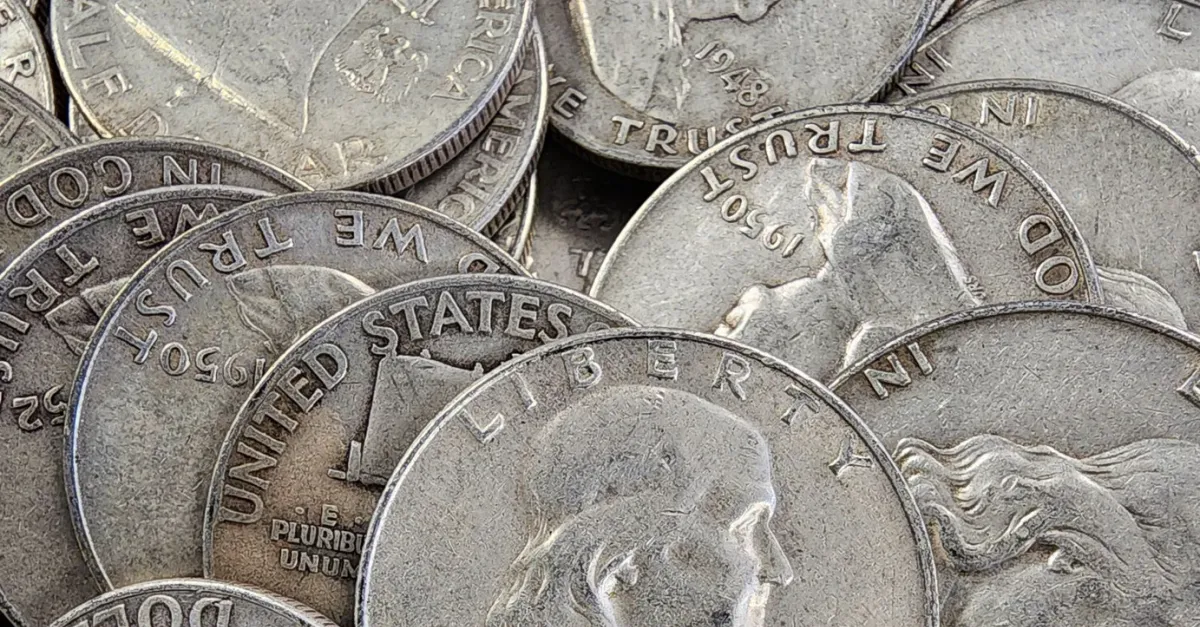
The United States only struck circulation half dollars with 40% silver for a brief window, yet these coins remain popular among bullion buyers and hobbyists alike.
If you’re wondering exactly how much silver sits inside a "40%" half dollar, and what that translates to in melt value, this guide breaks down the numbers, the qualifying dates, and the factors that influence worth beyond metal content.
U.S. coinage silver content is usually quoted as a percentage of total weight. In the case of 40% half dollars, the planchet is an outer clad of 80% silver bonded to a core of 21% silver, 79% copper. The final mix averages to 40% silver by overall weight.
These coins weigh 11.50 grams (0.404 troy ounces). Because only 40 percent of that weight is silver, the pure silver portion equals roughly 4.60 grams, or 0.1479 troy ounces.
Coin collectors often memorize 0.1479 troy ounces as the magic figure. It’s consistent across every 40% Kennedy half, no exceptions, because the U.S. Mint kept weight and composition identical from 1965 through 1970 and again for the 1976-S 40% issues.
Multiply that silver weight by the current spot price to estimate melt value. For example, with silver at $25 per ounce, one 40% half is worth about $3.70 in metal content alone.
Only a handful of dates qualify, all of them Kennedy designs:
Every other circulation Kennedy half dollar outside these ranges is either 90% silver (1964) or copper-nickel clad (1971 onward).
Bulk lots of common-date 40% halves usually trade near melt, particularly in circulated condition. Dealers often pay 90–95 percent of melt for quantity and resell at a modest markup.
Certain dates bring higher premiums. The 1970-D, released only in Mint Sets, commonly sells for $8–$15 in average uncirculated grades, far above its $3–$4 bullion value. High-grade proofs from the 1976-S silver set also command extra.
Date is the fastest clue, anything 1965–1970 or a Bicentennial with an "S" mint mark likely contains silver. Still, edge inspection helps: 40% halves show a lighter, silvery band mixed with a thin copper line, unlike the solid reddish edge of clad coins.
If you’re sorting large quantities, a simple magnet test (silver is non-magnetic) paired with a digital scale (11.5 g target weight) speeds the process. For absolute confirmation, specific-gravity or XRF tests can be used, but they’re rarely necessary for standard Kennedy halves.
They strike a sweet spot between affordability and silver exposure. Each coin costs only a few dollars over face value, making them accessible for new stackers and a convenient divisional increment compared to full one-ounce rounds.
Additionally, the Kennedy design carries historical significance tied to the 1960s, giving these coins crossover appeal with numismatists who prefer keeping at least a few nice examples instead of melting them down.
A 40% half dollar delivers 0.1479 troy ounces of fine silver, no more, no less, making its melt value easy to calculate against spot price. While most examples trade at bullion levels, key dates and pristine specimens can warrant meaningful premiums.
Whether you’re stacking silver, roll-hunting, or building a complete Kennedy run, understanding the exact composition helps you buy and sell with confidence and avoid confusing these mid-silver issues with their 90% or clad counterparts.

