

MENU
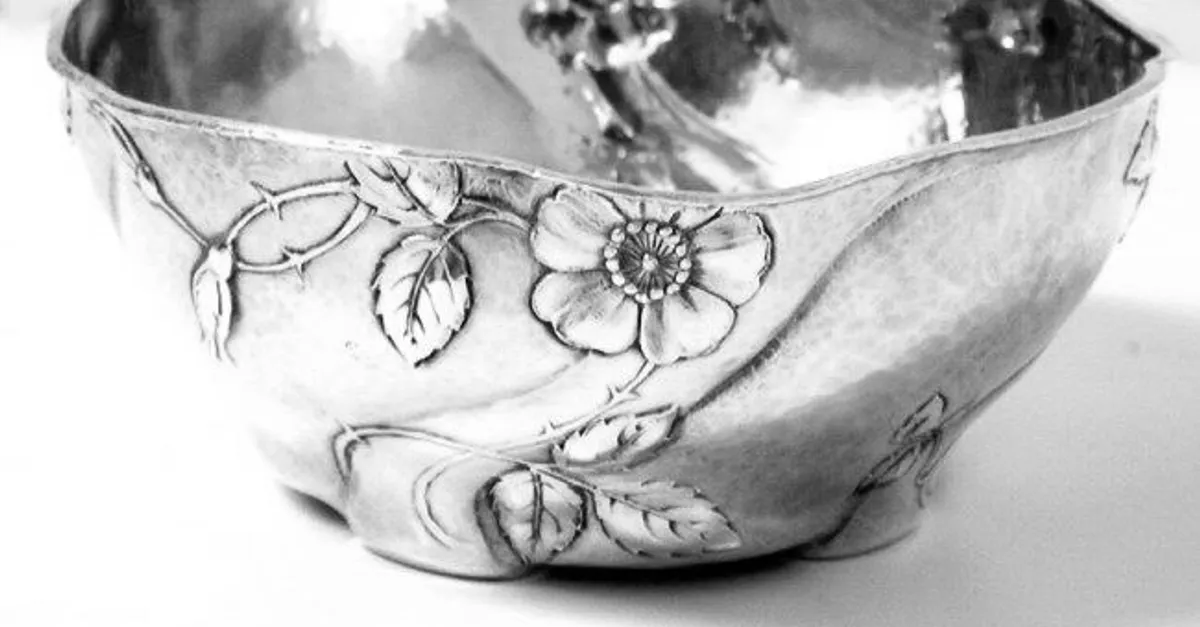
Among American silver makers, Gorham stands out for innovation and artistry. Nowhere is that more evident than in Martelé, a limited line of hand-hammered sterling produced at the turn of the 20th century.
Created for the 1900 Paris Exposition, Martelé married Art Nouveau aesthetics with painstaking craftsmanship. Fewer than 1,000 known pieces survive, making the series one of the most coveted categories in American decorative arts.
Gorham introduced Martelé in 1897 under the leadership of William C. Codman, the firm’s chief designer. The goal was to rival Europe’s premier silversmiths and showcase American artistry on a global stage.
Every item was crafted inside a special studio in Providence, Rhode Island. Only the company’s most skilled silversmiths, around 40 in total, were assigned to Martelé workbenches, and each artisan signed the pieces they completed.
Martelé translates from French as “hammered,” a nod to the visible planishing marks that give each surface a fluid, organic texture. Designs draw heavily on Art Nouveau motifs, languid iris blossoms, whiplash curves, and asymmetrical lines.
Because patterns were chased and repoussé-worked by hand, no two pieces are identical. This subtle individuality is a key reason collectors favor Martelé over Gorham’s machine-made flatware lines.
Unlike standard Gorham sterling, which is 92.5% pure, Martelé silver averages 950 parts per thousand. The higher purity allows for a softer working surface, ideal for deep chasing and elaborate relief work.
Silversmiths began with heavy gauge sheets, raising and planishing the form entirely by hammer. Ornamental details were then chased, and final finishes were burnished rather than buff-polished, preserving the distinctive texture.
True Martelé items carry a cursive "Martelé" cartouche, the Gorham lion-anchor-G hallmark, the numeral "950", and often the silversmith’s individual mark or code letter. Hollowware may also show a special production number beginning with "M".
Be wary of later Gorham pieces with hammered finishes but lacking the scripted mark or 950 purity stamp; these are not part of the Martelé line.
Martelé’s scarcity keeps demand high. Small desk accessories can start around $2,000, while coffee services, ewers, and presentation bowls regularly achieve five-figure prices at auction. Record results exceed $150,000 for large exhibition pieces.
Market momentum remains steady, driven by crossover interest from both silver specialists and Art Nouveau enthusiasts. Provenance, condition, and artistic complexity remain the three leading price drivers.
Because Martelé surfaces are intentionally textured, aggressive polishing can flatten hammer marks and diminish value. Use a mild, non-abrasive silver paste and soft cloth, working in the direction of the grain.
Store pieces in tarnish-resistant cloth or display cases away from humidity. When cleaning chased recesses, employ a soft natural-bristle brush rather than chemical dips, which may undercut fine detail.
Gorham’s Martelé line represents the height of American silversmithing, blending elevated silver purity, Art Nouveau artistry, and unmatched hand craftsmanship.
If you encounter a Martelé piece, whether at auction, an estate sale, or tucked away in family silver, careful authentication and gentle preservation will ensure its beauty and value endure for generations.

